Product Evaluation

— Unified EPM Assessment Framework
Find the EPM solution that
fits your business — not the other way around.
Find the EPM solution that fits your business — not the other way around.

Choosing an Enterprise Performance Management (EPM) platform is a major investment. With dozens of solutions offering overlapping capabilities, it’s hard to know which one truly fits your organization’s planning, reporting, consolidation, forecasting, and performance management needs. Our EPM Evaluation Platform helps you compare, shortlist, and select the right solution with confidence.

Recalculating
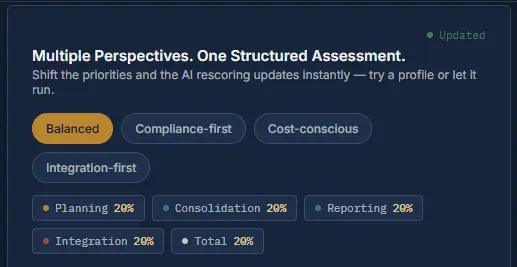
Multiple Perspectives. One Structured Assessment.
Shift the priorities and the AI rescoring updates instantly — try a profile or let it run.
Four disciplines, one AI framework
Four overlapping circles labeled BI, EPM, CPM, and ERP surrounding the center label Data Analysis and Reporting
Weighted ranking
Same four vendors, five criteria — the AI re-ranks them the moment priorities change.
Illustrative scores for demonstration — build an evaluation to score these vendors against your own requirements.

— Start Here
Find the Right Platform for Your Business

Start with the software category you need to evaluate. Each category uses a purpose-built evaluation framework with relevant criteria, vendor options, and scoring logic

Featured
01 · PLANNING & PERFORMANCE
EPM / CPM

Evaluate Enterprise Performance Management platforms across planning, budgeting, forecasting, consolidation, financial close, reporting, and performance management.

Featured

01 · PLANNING & PERFORMANCE

EPM / CPM

Evaluate Enterprise Performance Management platforms across planning, budgeting, forecasting, consolidation, financial close, reporting, and performance management.

02 · CORE OPERATIONS
ERP

Compare Enterprise Resource Planning platforms across finance, operations, supply chain, procurement, and other critical business processes.

 
03 · INSIGHT & REPORTING
Analytics & BI

Assess Business Intelligence and analytics platforms across reporting, dashboards, self-service analytics, data visualization, and enterprise analytics capabilities.

 
04 · DATA INFRASTRUCTURE
Data Platforms & Warehousing

Evaluate modern data platforms across data warehousing, lakehouse architecture, integration, engineering, scalability, and governance.

 
Featured
— How it works
From Requirements to Recommendation in Three Steps

Turn complex software selection into a structured evaluation process. Define what matters, assess vendors against consistent criteria, and build a recommendation you can confidently take to stakeholders.

01
Configure Your Evaluation

Choose your software category and vendors. Define your business and technical requirements, then assign weights based on their importance to your organization.

02
Evaluate Vendors with AI

AI assesses vendors against your weighted criteria using available research and evaluation inputs. See scores alongside the reasoning, strengths, limitations, and areas of fit for each vendor.

03
Compare and Build Your Recommendation

Review weighted scorecards, side-by-side comparisons, and vendor insights in one place. Export an executive-ready report with the evidence behind your recommendation.

— Our EPM Evaluation Methodology
Multiple Perspectives. One Structured Assessment.

No single source provides a complete picture of an EPM platform. Our methodology combines your requirements with standardized assessments, independent research, implementation perspectives, industry insights, and verified vendor information. Each source is assigned a defined weight to create a more balanced and transparent evaluation.

30%
Central Assessment

A standardized assessment of each vendor against core EPM capabilities and consistent evaluation criteria.

23%
Your Requirements

Your business priorities and evaluation criteria ensure the assessment reflects what matters most to your organization.

15%
Analyst Research

Independent analyst research provides broader market context, vendor positioning, and capability perspectives.

15%
Consultant Insights

Practical implementation experience adds context around usability, complexity, deployment considerations, and real-world business fit.

23%
Industry Influencers

Expert and industry perspectives provide additional context around emerging capabilities, market developments, and vendor strengths.

15%
Vendor Input

Official documentation and verified vendor information provide direct insight into product capabilities and functionality.

The percentages shown are not fixed. You can adjust each source weight based on your organization's requirements and priorities.

— What makes our approach different
Move Beyond Spreadsheets and Subjective Scoring

Traditional software evaluations often depend on disconnected research, spreadsheets, manual scoring, and individual opinions. Our platform brings the process together in one structured environment.

Traditional Software Evaluation

✕   Spreadsheet-based evaluation

✕   Manual scoring

✕   Generic evaluation criteria

✕   Equal importance across criteria

✕   Research across multiple sources

✕   Difficult vendor comparisons

✕   Static findings

✕   Weeks of manual effort

Our Approach

✓   Structured evaluation workflow

✓   AI-assisted analysis

✓   Requirements tailored to your business

✓   Weighted priorities

✓   Centralized evaluation inputs

✓   Side-by-side scorecards

✓   Interactive evaluation insights

✓   Faster path to a shortlist

— Who it's for
Built for Teams Making High-Stakes Software Decisions

Help every decision-maker evaluate vendors against the criteria that matter most to their role and organization.

cfo & finance
Finance Leaders

Evaluate platforms against finance, planning, reporting, and transformation priorities.

cio & technology
Technology Leaders

Assess architecture, integration, scalability, governance, and technical fit.

procurement
Evaluation Teams

Bring structure and consistency to vendor shortlisting and comparison.

 
Consultants
Transformation Teams

Build evidence-backed evaluations and recommendations for stakeholders.

 
Your Requirements. Your Priorities. A Clearer Decision.

Enterprise software selection should not come down to the loudest vendor, the longest feature list, or a collection of disconnected opinions. Build an evaluation around what your organization actually needs, compare vendors using a consistent methodology, and see the evidence behind every recommendation.